
The Gang Intervention Partnership: A Personal Reflection
by John De Taeye and CSC Editor
John has been part of the CSC community since 2001. In his role of Weed and Seed Coordinator and later Director of Community Capacity Building, he helped establish the Gang Intervention Partnership model. He later served on the staff of Ward One Councilmember Jim Graham and helped initiate legislation that would extend the GIP model and related youth programs into neighborhoods beyond Ward One.
Overview
The Gang Intervention Partnership (GIP) was established on August 5, 2003. The Partnership between law enforcement and community demonstrated that with strong public support, consistent funding, a shared value system, and common, evidence based practices, collaboration between public agencies and community-based support networks can effectively protect children, keep families together, and communities safe, even in the face of significant challenges and obstacles.
Over two decades, the GIP model was evaluated three times regarding its implementation throughout the District of Columbia:
Center for Youth Policy Research, 2006
Center for Evidence-Based Crime Policy, George Mason University, 2016
Street by Street: Cross-Site Evaluation of OJJDP Community Based Violence Prevention, John Jay College, 2016
In 2009, the Healthy Families/Thriving Communities Council published the Blueprint for Action: Responding to Gang, Crew, and Youth Violence in the District of Columbia which led to City Council legislation establishing the Gang and Crew Intervention Working Group.
And in 2022, the District of Columbia incorporated a portion of the Washington, DC Gun Violence Reduction Strategic Plan, National Institute for Criminal Justice Reform.
Please take a moment to review each document through the links provided. Each report offers an in-depth look at the practices, processes, and outcomes of the GIP model.
I am honored to share the GIP story, which reflects one Collaborative’s strategy to implement the values, principles, and practices of the larger Collaborative Movement. This mission aims to keep children safe, families together, and communities thriving. What follows is a brief and personal account of a much larger narrative that I hope can be explored in greater depth in the near future. There is a more extensive and detailed story here that needs to be shared.
I dedicate this article to the memory of so many young people we have lost to gun violence in the District of Columbia. Their shortened lives inspire me every day to try to live my extended life more fully. Their families and friends remain close to my heart. I am also mindful of the hundreds of street outreach workers, school staff, law enforcement officers, policy makers, community leaders, hospital personnel, attorneys, judges, and so many others who dare to believe that violence is not inevitable.
Your ongoing individual and collective witness to keep young people and communities safe is saving lives.
How We Got Here
As we have discussed in previous newsletter articles, the Healthy Families/Thriving Communities Collaboratives and Collaborative Solutions for Communities (CSC) (formerly the Columbia Heights/Shaw Family Support Collaborative) have been at the forefront of the District of Columbia’s efforts over the last 30 years to establish a neighborhood-based network of support services alongside - - and an alternative system - - to the traditional child welfare system. This framework includes three interconnected objectives: ensure the safety of children and youth; assist families in finding pathways to stability and success in a competitive, and at times challenging, local and global economy and political landscape; and finally, activate and mobilize existing neighborhood leaders to strengthen and organize the community’s collective power and resilience, ensuring that we can keep each other safe - - especially our children and youth.
At the 1997 inaugural city-wide gathering of the Collaboratives, Ralph Smith, then Vice President of the Annie E. Casey Foundation, challenged the Collaboratives to immerse ourselves in under-resourced communities and to leverage the inherent human assets within these so-called distressed neighborhoods. His vision for us was to “figure out how to match the formal with the informal, the funded with the unfunded, and the formally trained social worker with the indigenous community leader who can speak truth within the community.”
For 30 years, this has been the vision and work of the Collaboratives. Our efforts continue to improve the lives of thousands of children and families and to strengthen neighborhoods in every quadrant of the District of Columbia. As we celebrate this milestone, we also recognize the new opportunities and challenges that lie ahead.
When thinking about the history of the universe, even the 250 year history of this country, 30 years is a drop in the bucket in the larger scheme of life. But for those of us who were in the trenches or on the periphery of the Collaborative Movement to say the District has changed a lot since 1996, is a wild understatement. However, I imagine that friends who lived in the District in 1966 might say the same about 1996. But I digress.
James Baldwin reminds us, “History is not the past. It is the present. We carry our history with us; we are our history. If we pretend otherwise, we are literally criminals.” Trauma research seems to support what Baldwin came to know through life experiences. In the District of Columbia, the shiny new landscape of modern buildings, narrowed avenues, and prevalent bike lanes cannot erase the reality that we remain a disenfranchised colony of our federal government, facing extreme inequities in our neighborhoods, and one in three children in the District living in poverty. Yes, much has changed. But under the surface, and literally around the corner – a lot has not changed. We risk becoming complicit with the ongoing structural and systemic, unjust barriers we face if we allow ourselves to be misled by superficial newness. History is now. “We are our history.”
The Gang Intervention Partnership: Created out of Necessity, Not Idealism.
“We come to this partnership out of necessity. Not out of some romantic sense of idealism,”
Ralph Smith, 1997 Keynote Speech
Each Collaborative has a signature program in which every aspect of the larger vision of the Collaborative Movement is integrated within our praxis (the circular process between theory, action, and reflection) - - one core program that we can lift up and say, in this program we can say with deep confidence, “we are keeping children safe, we are supporting their families, and we are activating and organizing resilient, supportive, powerful neighborhood leaders.”
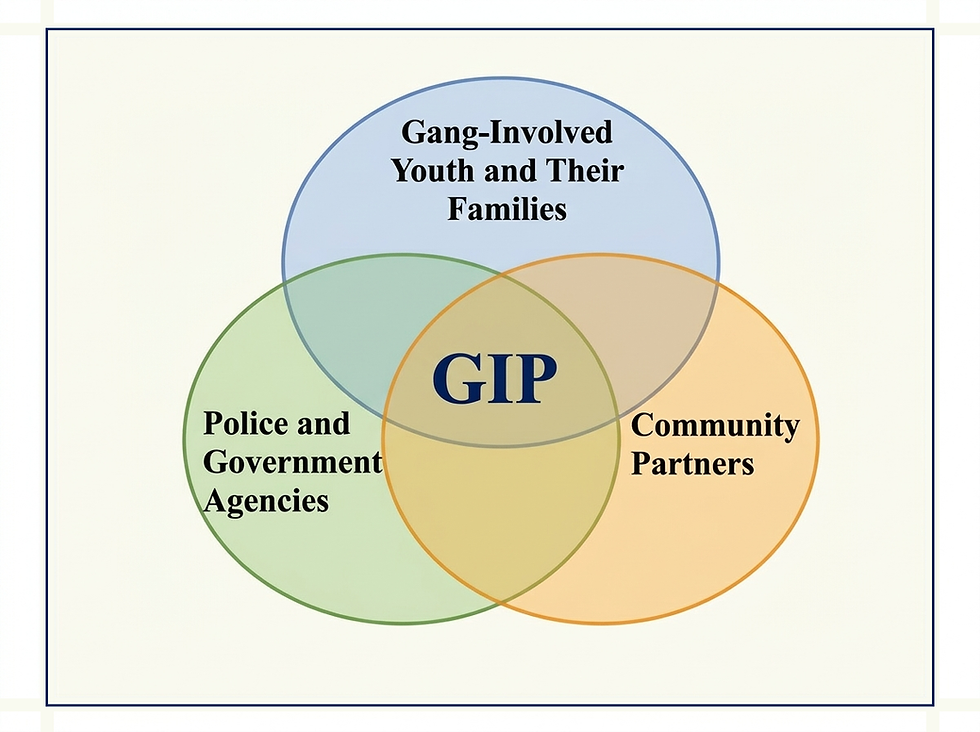
The GIP story illustrates how CSC organized a neighborhood-based violence prevention strategy. The initiative was informed by both traditional and non-traditional social work and community organizing practices aimed at fostering child safety, family support, and community empowerment. Where other violence prevention programs during the same period in the District and cities across the country focused on working exclusively with individuals and mediating truces between rivaling groups, the GIP model focused on the young person, his or her traditional and non-traditional family members, and the larger community.
The GIP was established in response to widespread youth violence in many neighborhoods across the District, not in a political or economic vacuum. The child welfare and juvenile justice systems were under court supervision, while President Clinton and the Republican Congress celebrated so-called “welfare reform” alongside tax cuts for the wealthiest citizens. The DC Control Board was overseeing all of the District’s financial expenditures with political implications. (political = who gets what, and when) Mayor Anthony Williams, who was favored by the Control Board, called for the addition of 100,000 new residents to the District as pockets of gentrification began to emerge. For long-time Black residents of the District, the unstated goal of the Johnson Administration’s “Urban Renewal” programs—to shift “Chocolate City” back to a white majority—was accelerating.
The traditional child welfare system was failing and, in many cases, causing more harm than good. At the same time, the District was grappling with a crack epidemic and a homicide rate that infamously earned us the title of "Murder Capital of the World."
Shortly after the Collaboratives were established, the CSC secured federal funding through the US Department of Justice in 1999. Ironically, programs known as “Weed and Seed” also recognized the potential of a neighborhood-based approach to increasing safety. However, unlike the Collaboratives, which were created to keep children safe with a focus on innovative social work practices and community organizing, the Weed and Seed initiative required a law enforcement component to establish safety. The terror of the 9/11 attack on the World Trade Center and Pentagon seemed to elevate and expose to the larger DC population the fear of violence that many of young people and their families were experiencing daily. With community suspicion and unease with local law enforcement and “Immigration and Naturalization Services” (INS) already high, most agreed that “necessity” required a new strategy which included building trust among all parties.
After one incident, then DC Police Chief Charles Ramsey said, "These guys don't care. They start throwing lead around, they could care less about consequences for other citizens."
Between 1999 – 2003, 21 young people were killed in the Columbia Heights / Mt. Pleasant / Shaw neighborhoods alone. 40 were injured by gunfire or stabbing. The police seemed unable to keep the community safe. The community was unable to keep our children and families safe. With suspicions high and “both sides” shaking our fingers at the other, it was out of necessity that GIP was established.
The August 8, 2002 Washington Post headline read, “Slayings Follow Peace March.” Three men were shot dead, two of whom were killed on 14th St. within walking distance of the Collaborative office. Janet Martin, among CSC’s founding staff members and longtime Columbia Heights resident and leader, was grieving the loss of her son. At that point in 2002, there were 148 homicides in the District, up from 109 the same time the previous year.
One year later, July, 2003, five young people would be killed and several others wounded in retaliatory shootings. In one case, an infant was caught in the crossfire while sleeping in a car. Another young man was killed on the sidewalk in front of a very busy community center. Miraculously, the death toll was not higher. Between 1999 – 2003, 21 young people were killed in the Columbia Heights / Mt. Pleasant / Shaw neighborhoods alone. 40 were injured by gunfire or stabbing. The police seemed unable to keep the community safe. The community was unable to keep our children and families safe. With suspicions high and out of frustration, weariness, fear of what will happen next and both sides pointing our fingers at the other, it was out of necessity that GIP was established.
On August 5, 2003, MPD Chief Ramsey, Mayor Anthony Williams, and Councilmember Jim Graham formally established the GIP. Co-leadership was crucial to the agreement between law enforcement and the community. Chief Ramsey accepted the community’s recommendation to appoint Sgt. Juan Aguilar as the MPD co-leader. Community partners identified Marian Urquilla, CSC Director at the time, as the community co-leader. A key element of the Weed and Seed strategy involved the creation of a multi-agency Task Force on Truancy, Violence, and Substance Abuse. The task force had been meeting weekly since April 2001. Through their work, they built relationships of trust and established protocols for responding to violence. Their efforts formed the foundation for what became GIP.
The Three “P’s”
“We have come to this partnership because across the country a realization that we can predict with amazing certainty the children who will fail, who will experience rotten outcomes, and whose futures will be compromised by circumstances over which they have no control.”
Ralph Smith, 1997 Keynote Speech.
In 2026, Smith’s comment may be interpreted as another form of implicit and cultural bias. But this would be mistaken. Smith’s point in 1997 was that zip codes can help expose communities where there has been historically inadequate and equitable economic and political investments and the result in many cases are higher rates of child abuse and neglect, lower academic achievement, unstable housing, and higher rates of crime.
A similar thought pattern would become the basis of the GIP strategy. By establishing and nurturing trusting multi-sector, formal and informal relationships and confidential information sharing among those entities, we could almost predict the next round of violence that may occur. Smith reminded us the real so-called “prevention” work - - whether it is preventing child abuse and neglect or preventing violence with guns and knives - - is in and with communities. This realization reminds us that we cannot depend on public agencies alone - - whether it is the child welfare system or law enforcement agencies - - no matter how well those public agencies are funded or the best of intentions, when given a chance and the resources, communities are best equipped to keep communities safe.
It was through this realization that GIP established a shared value system among its partners. Facing profound levels of violence, sadness, and brokenness, we recognized the need for a bold set of values to guide our collective effort. If we were to be successful in finding a sustainable peace, these values -- The Three P’s -- couraged each individual and organization we represented to stretch beyond our comfort zones and traditional ways of operating - - would be our guide.
Violence is Preventable.
Remember the Big Picture.
Partnerships are essential.
As one GIP member reflected at the time and remains true today, “It will require a lot more from us to move individuals and institutions to a mind set that murders and violence are not normal or inevitable….We need to create new expectations for ourselves. We need to create a public sentiment of zero tolerance for violence. We must change the attitude that certain lives are expendable.”
GIP Core Elements and Practices
The cornerstone of the GIP framework included the entire community. If one young person or family was struggling through a violent incident -- either as a person who has been harmed or one who has caused harm -- the entire community was organized to support both. We called it the Web of Support. If a partner had an existing or anticipated future relationship with a young person who had been involved in a violent incident, that partner would participate in developing a safety plan that addressed the short and long term interests of that young person and their family. Each partnering organization - - community partners as well as public agencies - - were trained in the CSC’s Core Practices which included strength-based interviewing, Solution Focus Brief Therapy, Family Group Conferencing / Restorative Justice, and Trauma Informed Care. It was critical that all of the partners were utilizing the same skill sets in our collective work. An in depth look at each of these practices can be found in Thirty Years of ReCentering Authority: CSC Core Practices.

The GIP model has evolved over the past 20 years, adapting to the unique needs and potential of each specific community where it is implemented. Central to the model are the following strategies.
Partnerships. Identifying and building a strong, multi-sector partnership between law enforcement, youth serving organizations, court services, community organizations, schools, public agencies, private sector, and parents. Each partnering group commits to identify and allocate resources from their respective organizations as needed and participate in Core Practices training. It is impossible to overstate the importance of trust among members of the partnership. We learned early on exchanging information -- street level information and agency based information -- actually saves lives. Creating a process in which information can be shared while preserving confidentiality develops over time.
Outreach. Development of a Street Outreach Team who has eyes and ears on the ground and has the credibility to speak truth in the community across all sectors of the community. Because the Outreach Team has the most direct contact with young people and the trauma associated with gun and street violence, it is critical the team have opportunities to process that trauma and exercise frequent self care. We call this essential part of the work, “The Cool Down.”
Family Support. Grounded in the history of the Collaborative Movement, GIP is a family-centered intervention process, engaging parents, extended family members, and key friends throughout the process. This is one of the key distinguishing components to the GIP model from other youth violence intervention strategies.
Protocol. We realize that violence does occur. But retaliations to violence can be predicted and stopped. We often say, “we are in the business of making sure bad things don’t happen.” The Critical Incident Protocol evolved over time and in countless instances, has prevented the escalation of community violence. The implementation of the protocol is only as good as the trust that has built up within members of the partnership.
Social Corners. Inspired by Peter Block’s “Small Group” work, social corners are staffed by Outreach Workers, strategically located on a block or neighborhood where a recent violent incident occurred and is designed to connect residents with residents, and organizations with residents. When positive connections are made, especially after a traumatic incident of a shooting, to serve as a reminder that young people are safer - - and the community as a whole is safer - - when we are working together for each other’s safety.
Training. As one recent Outreach Worker said at a community gathering, “Training. Training. Training. It pays off -- not only at work, but at home.” Individual staff development and organizational capacity building is a fundamental component to CSC’s overall mission.
Conclusion
In his book “What Every Person Should Know About War”, Christopher Hedges estimates that out of 3,400 years of recorded history, the world was entirely at peace for only 268 years. That’s about 8% of our human history. The group “War Costs” suggests that in the 250 years of the United States' history, the country has been at war for at least 229 of those years. And yet, in his book “We Keep Us Safe: Building Secure, Just, and Inclusive Communities,” Zach Norris challenges us, “Since the founding of this country, the notion of “versus” has been key to our identity and safety. Man vs. nature. American vs. un-American. Good guys vs. bad guys. Profit vs. workers. If safety is anything, it is relationship and connection. Real safety happens when we bridge the divides and build relationships with each other, overcoming suspicion and distrust. Real safety comes from strategic, smart investments—meaning resources directed toward our stability and well-being. Real safety addresses the harms that the current system is failing to tackle and holds people accountable for those harms while still holding them in community. Real safety results from reinstating full humanity and agency for everyone who has been dehumanized and traumatized, so they can participate fully in society. If we are able to transform our old system and create a culture of caring and healing in its place, we may have an actual shot at creating real democracy for the first time."
Let’s keep our sleeves rolled up.
Peace.